
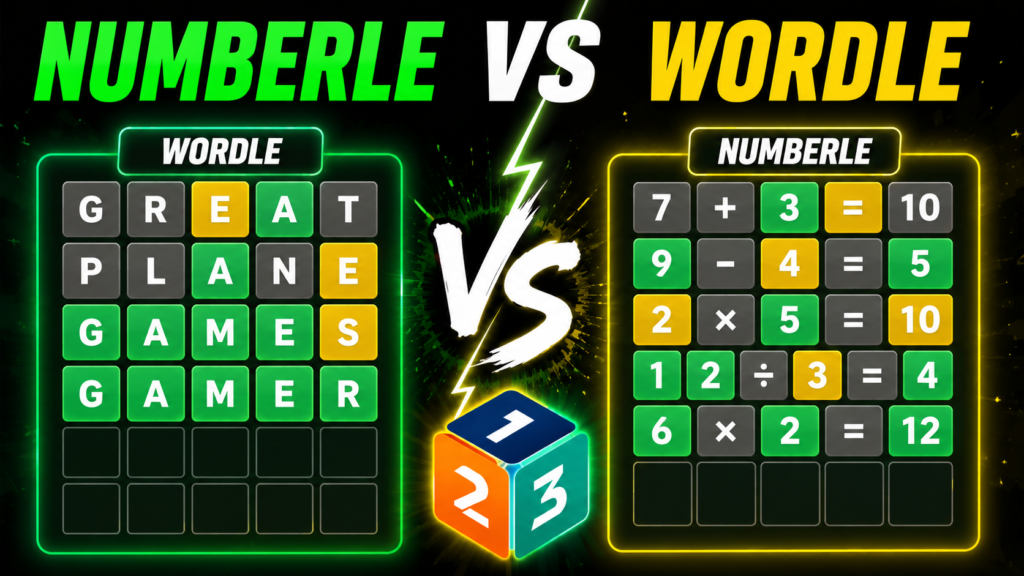
By now, almost everyone has heard of Wordle — the simple daily word game that took the internet by storm in 2022. But if you’ve landed here, you’ve probably also come across Numberle and wondered: are these two games basically the same thing, or is there something genuinely different going on?
The short answer is: they share the same core format, but they feel completely different to play. One tests your vocabulary. The other tests your mathematical thinking. And depending on who you are, one will feel far more satisfying than the other.
Let’s break it down properly.
The Basic Concept — What They Have in Common
Before getting into the differences, it’s worth acknowledging what makes Wordle and Numberle feel like cousins in the first place.
Both games give you a hidden answer to figure out. Both give you six attempts. Both use a color-coded feedback system — green for correct position, yellow for wrong position, gray for not present at all. Both reset every 24 hours with a fresh daily puzzle. And both can be played free in any browser with zero downloads required.
That shared structure is why people who love Wordle tend to discover Numberle naturally. The learning curve is almost zero if you’ve played one before.
The Big Difference — Words vs Equations
Here’s where everything changes.
In Wordle, you’re guessing a hidden five-letter word. Your guesses also have to be real words — you can’t just type random letters. The challenge is vocabulary-based: do you know enough words to make smart guesses? Do you remember which letters you’ve already eliminated?
In Numberle, you’re guessing a hidden mathematical equation. Not just a number — an entire equation, like 4*3=12 or 7+8=15. Your guess must be a valid, balanced equation every single time. That means both sides of the equals sign must actually be correct mathematically.
This is the fundamental shift that makes Numberle feel different. You’re not asking yourself “what word fits these letters?” — you’re asking “what equation is mathematically possible given these clues?”
Difficulty Comparison
This one really depends on your brain type.
Wordle difficulty comes from the sheer number of possible five-letter English words. If you’re not a strong reader or don’t have a wide vocabulary, some days feel nearly impossible. Common letters like E, A, R, T, and S help a lot — but certain puzzles use unusual words that stump even experienced players.
Numberle difficulty comes from the constraints of mathematics. You can’t just type anything — every guess must be a valid equation. This actually helps in one way: you’re never guessing blindly because math rules eliminate huge portions of possibilities automatically.
That said, Numberle can feel harder for people who aren’t comfortable with mental arithmetic or who struggle to quickly think of valid equations on the spot. If multiplying and dividing numbers in your head feels slow, the six-attempt limit can feel tight.
For most people: Wordle is easier to start, Numberle is more rewarding to master.
Side-by-Side Comparison
| Feature | Wordle | Numberle |
|---|---|---|
| What you guess | A 5-letter word | A math equation |
| Valid guesses must be | Real English words | Balanced equations |
| Skills tested | Vocabulary, pattern recognition | Arithmetic, logic |
| Tile colors | Green, Yellow, Gray | Green, Yellow, Gray |
| Daily puzzles | Yes — one per day | Yes — one per day |
| Attempts allowed | 6 | 6 |
| Answer length | Fixed (5 letters) | Varies by equation |
| Free to play | Yes | Yes |
| Best for | Word lovers | Math and logic fans |
The Color System — Same Colors, Different Meaning
Both games use green, yellow, and gray tiles — but what those colors represent is slightly different in practice.
In Wordle, the colors apply to individual letters. A yellow “A” means the letter A is somewhere in the word, just not in the position you placed it.
In Numberle, the colors apply to digits and mathematical symbols. A yellow 3 means the number 3 appears in the equation, but you put it in the wrong spot. A yellow + means the addition sign is used in the equation, just not where you placed it.
This adds an extra layer of complexity in Numberle — you’re tracking the position of both numbers and operators simultaneously. Some players find this overwhelming at first, but it clicks quickly once you understand that operators are just as important as the digits.
Who Should Play Wordle?
Wordle is perfect for you if:
- You enjoy language, reading, and vocabulary challenges
- You like puzzles that feel accessible to everyone in the family
- You want something quick and low-pressure in the morning
- You prefer guessing games where logic matters but math doesn’t
Wordle’s biggest strength is its universality. Almost anyone can play it — kids, grandparents, non-native English speakers who want vocabulary practice. The rules take about thirty seconds to learn.
Who Should Play Numberle?
Numberle is the better choice if:
- You enjoy math, logic puzzles, or brain teasers
- Wordle feels too easy or you’ve “solved” it in two tries too many times
- You’re a student or teacher looking for something that sharpens arithmetic skills
- You like the feeling of working through a logical problem step by step
Numberle rewards systematic thinking. The more you understand how math constrains the possible answers, the better you get — and that improvement feels genuinely earned.
Can You Play Both?
Absolutely — and many people do. Wordle and Numberle each take about five minutes to solve, so doing both as a morning routine is completely realistic. They work different parts of your brain, which makes them a surprisingly good pair.
Some players start with Wordle to wake up their language brain, then switch to Numberle for a more focused logical challenge. Others do it in reverse. There’s no wrong order.
The Verdict
Wordle and Numberle are built on the same skeleton, but they deliver very different experiences. Wordle is the word lover’s game. Numberle is the number lover’s game. Neither is objectively better — they just appeal to different kinds of thinkers.
If you’ve never tried Numberle before and you’re comfortable with basic math, there’s a good chance you’ll enjoy it just as much as Wordle — maybe more. The equations feel more satisfying to crack than words do, because every correct guess is the result of actual logical reasoning, not just a lucky vocabulary recall.
Give it a shot. One puzzle a day, zero commitment, completely free.
👉 Play Numberle now at numberle.pro
Frequently Asked Questions
Is Numberle harder than Wordle?
It depends on your strengths. Numberle requires basic arithmetic and logical thinking, while Wordle relies more on vocabulary. Math-oriented players often find Numberle easier. Word-oriented players usually prefer Wordle.
Can I play Numberle if I’m bad at math?
Yes! Numberle only uses basic operations — addition, subtraction, multiplication, and division. You don’t need advanced math skills, just comfort with simple equations.
Is Numberle free to play?
Yes. Numberle is completely free to play at numberle.pro. No account, no download, no payment required.
Do Wordle and Numberle have the same rules?
The core format is the same — six guesses, color-coded feedback, one daily puzzle. The main difference is that Wordle accepts any real word, while Numberle only accepts mathematically valid equations.
Enjoyed this comparison? Try today’s Numberle puzzle at numberle.pro and see how fast you can solve it.